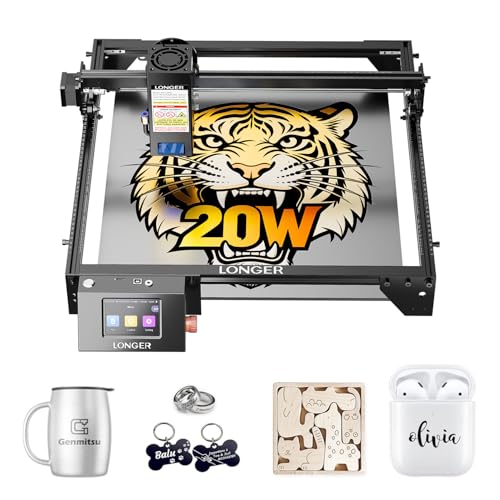

You have a growing list of custom metal engraving orders, but your current setup struggles with speed and precision. Whether you are a small business owner, a jewelry maker, or a hobbyist looking to scale up, choosing the best fiber laser machine can transform your workflow. This guide reviews six top-rated models from trusted brands like xTool, Monport, and G·WEIKE, focusing on power, speed, and versatility for 2026. For those just starting out, our guide to beginner fiber laser engravers offers a helpful foundation.


Buying Guide
Power Output and Material Compatibility
Fiber laser machines range from 20W to 60W, each suited for different tasks. A 20W fiber laser can engrave all metals and some thin sheets, while 30W to 60W models handle deeper engraving and cutting thicker materials. For example, the 60W MOPA fiber laser in the xTool F2 Ultra supports color engraving on stainless steel and even laser cleaning. If you primarily work with metals like gold, silver, or titanium, a higher wattage ensures efficiency and quality.
Engraving Speed and Accuracy
Speed is critical for batch production. Machines like the GWEIKE G2 Pro reach 15,000 mm/s, while others operate at 10,000 mm/s. Accuracy down to 0.001 mm ensures fine details in jewelry or industrial parts. Look for models with galvanometer systems and F-theta lenses, as they maintain precision across the entire work area. For a deeper look at speed comparisons, check out our GWEIKE G2 Plus 20W review.
Software and Ease of Use
Compatibility with LightBurn is a major advantage, as it offers advanced design tools and a user-friendly interface. Some machines also include proprietary software or support Wi-Fi and USB connections. Features like auto-focus, red dot pointers, and AI-powered cameras simplify setup, making them accessible for beginners. If you are on a budget, our best budget fiber laser guide highlights affordable options with solid software support.
Work Area and Expandability
The working area determines the size of items you can engrave. Desktop models typically offer 150×150 mm to 220×220 mm, with some expandable via conveyor systems for batch processing. A larger work area is ideal for signage or larger metal parts, while compact machines suit small workshops. For high-volume needs, models with auto conveyors can handle continuous production without manual intervention.
Final Thoughts
After evaluating these top fiber laser machines, the xTool F1 Ultra 20W Fiber & Diode Dual Laser stands out for its dual-laser versatility and camera system, making it perfect for mixed-material projects and in-store customization. For those needing industrial-grade metal engraving and color capabilities, the xTool F2 Ultra Deluxe Bundle with its 60W MOPA laser offers unmatched speed and precision for high-volume orders. Whichever you choose, these machines will elevate your engraving business to new heights in 2026.
Frequently Asked Questions
What materials can a fiber laser machine engrave?
A fiber laser machine can engrave all metals, including gold, silver, copper, stainless steel, brass, and titanium. Some models also handle plastics, ceramics, leather, and stone. The 1064 nm wavelength is ideal for metal marking, while MOPA versions add color engraving on stainless steel.
How fast is a fiber laser engraver?
Fiber laser engravers typically operate at speeds from 10,000 mm/s to 15,000 mm/s, depending on the model and power. High-speed galvanometer systems allow for rapid batch production without sacrificing detail. For example, the GWEIKE G2 Pro reaches 15,000 mm/s, making it one of the fastest in its class.
Is a 20W fiber laser enough for deep engraving?
A 20W fiber laser can perform deep engraving on metals, but it may require multiple passes for significant depth. For deeper results or cutting thin metals, a 30W to 60W machine is recommended. The xTool F1 Ultra’s 20W fiber laser handles 3D embossing effectively, while higher wattage models like the Monport 60W offer faster deep engraving.
What software do I need for a fiber laser machine?
Most fiber laser machines are compatible with LightBurn, a popular software for design and control. Some brands also include free software like BSLcad or proprietary apps. For a comprehensive look at software options, see our Monport 60W fiber review which covers LightBurn integration.