🔥 3D Printer Black Friday Deals: picks worth watching →
You need a 3D scanner that delivers accurate, detailed captures for your projects, whether you are into 3D printing, reverse engineering, or digital archiving. The best rated 3D scanner can make the difference between a model that fits perfectly and one that requires hours of cleanup. This guide covers the top models from leading brands like Creality, Revopoint, and 3DMakerpro, helping you choose the right tool for your specific needs.
We have evaluated each scanner based on precision, scanning speed, ease of use, and versatility, so you can make an informed decision. For a broader look at affordable options, check out our best budget 3D scanner guide.




Buying Guide
Accuracy and Precision
Accuracy determines how faithfully the scanner reproduces the original object’s dimensions. For 3D printing and reverse engineering, look for models with single-frame accuracy of at least 0.1 mm. The Revopoint MIRACO Plus achieves 0.04 mm point cloud accuracy, while the Creality Raptor Pro reaches 0.02 mm. Higher precision reduces post-processing time and improves fit.
Scanning Speed and Modes
Fast scanning saves time, especially for large objects. The Creality Pika can capture up to 110 frames per second, while the Revopoint MetroY Ultra reaches 90 fps. Many models now offer multiple scanning modes, such as blue laser for fine details and NIR structured light for full-color body scans. This flexibility lets you handle different materials and sizes efficiently. For more on versatile options, see our best 3D scanner under $2K guide.
Ease of Use and Portability
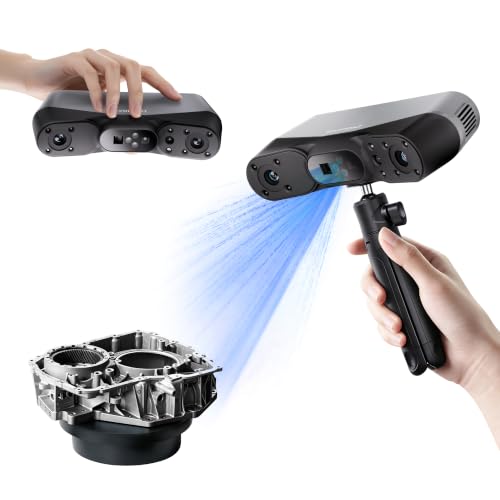
Handheld scanners with built-in screens, like the Creality Pika with its 3-inch touchscreen, simplify on-the-go scanning. Lightweight designs under 300 grams, such as the Creality Ferret Pro at 105 grams, reduce fatigue during extended use. Wireless connectivity via Wi-Fi 6 eliminates cable clutter and allows remote monitoring. Consider your workflow: if you scan outdoors often, models with detachable IR filters handle bright sunlight up to 100,000 lux.
Material Compatibility
Not all scanners handle dark, shiny, or transparent surfaces well. The Creality Raptor Pro can scan black metal and even 71% transparent glass without spray coating. The Revopoint POP 4 uses 30-cross blue laser lines to capture high-reflectivity objects. If you work with challenging materials, choose a scanner that supports markerless tracking and no-spray scanning to save preparation time. For turntable-assisted scanning, explore our best 3D scanner with turntable recommendations.
Final Thoughts
After reviewing the top contenders, the Creality Pika Portable 3D Scanner,0.03mm Blue stands out for its dual-mode scanning, AI-powered features, and compact design, making it ideal for creators who need high precision and portability. For professionals requiring industrial-grade accuracy and versatile scanning modes, the Revopoint MIRACO Plus 3D Scanner, All-in-One Scan offers exceptional photogrammetric metrology and powerful hardware. Both models represent the best rated 3D scanner choices for 2026, depending on your specific use case.
Frequently Asked Questions
What is the best rated 3D scanner for beginners?
The 3DMakerpro Fox 3D Scanner is an excellent entry-level option with its 0.07 mm accuracy and markerless tracking. It works well for small to medium objects and includes user-friendly software. However, achieving great results requires some patience and basic CAD knowledge.
Can I scan dark or shiny objects without spray?
Yes, many modern scanners like the Creality Raptor Pro and Revopoint POP 4 can scan black, metallic, and even transparent surfaces without spray coating. They use advanced blue laser technology and algorithms to handle challenging materials directly.
How fast can a 3D scanner capture a full body scan?
The Creality Pika can complete a full body scan in about one minute using its NIR structured light mode. The Raptor Pro achieves a full-body scan in roughly two minutes. Speed depends on the chosen scanning mode and object complexity.
What file formats do 3D scanners export?
Most scanners export common formats like STL, OBJ, PLY, and ASC, which are compatible with 3D printing and CAD software. Higher-end models also support 3MF, GLTF, and FBX for broader integration. For more on filament compatibility, check our creality PLA RFID review.