

You have a small part, a prototype, or a collectible that needs to be digitized for 3D printing, but traditional scanning methods feel slow, bulky, or too complex. The Creality Pika family of portable 3D scanners aims to change that, offering a compact, wireless solution that brings professional-grade scanning to your desk or workshop. This review covers the entire Creality Pika series, along with the Sermoon S1 and Ferret Pro, so you can decide which model fits your workflow and budget. Whether you are a hobbyist, a designer, or a small business owner, these scanners promise to turn physical objects into printable digital models with minimal fuss. For a broader look at the category, check out our guide to the best 3D scanner for 3D printing.



Buying Guide
Scanning Precision and Detail Capture
The resolution of a 3D scanner directly affects the quality of your digital model. The Creality Pika models offer 0.03mm accuracy, which is enough to capture the fine details of coins, mechanical parts, and figurines. The Sermoon S1 pushes this further with 0.02mm precision, making it a strong choice for industrial reverse engineering or inspection tasks. For larger objects like furniture or body scans, the Ferret Pro provides 0.1mm accuracy, which is more than adequate for most hobbyist needs. Consider the smallest detail you need to reproduce when choosing between these tiers.
If you work with reflective or dark surfaces, note that the blue laser mode on the Pika and Sermoon S1 does not require spray coating, saving time and preserving the original object. The Ferret Pro, however, works best on matte surfaces and may struggle with highly reflective or transparent items. For more advice on matching scanner specs to your projects, see our best 3D scanner roundup.
Light Source and Versatility
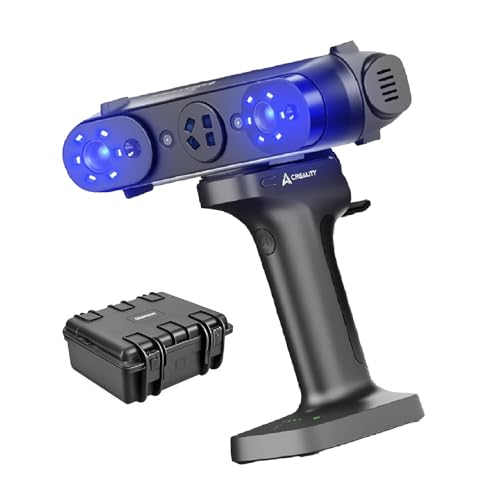
Dual-light systems are a game-changer for 3D scanning because they let you switch between capturing fine details and scanning larger objects. The Pika series uses a 7-line blue laser for precision work and NIR structured light for full-body scans, all in one device. The Sermoon S1 offers even more flexibility with five working modes, including single-line and 34-line lasers, adapting to objects as small as 5mm or as large as a person. The Ferret Pro relies on structured light only, which is simpler but less versatile for small or intricate parts.
Outdoor scanning is another consideration. All Pika models include a detachable IR filter that handles up to 80,000 to 110,000 lux, making them usable in bright sunlight. The Sermoon S1 also excels outdoors with support for up to 100,000 lux. The Ferret Pro is limited to 30,000 lux, so it is best kept indoors. If you plan to scan objects on location, prioritize a model with strong ambient light resistance.
Ease of Use and Portability
Wireless operation and a built-in display greatly simplify the scanning process. The Pika models feature a 3-inch touchscreen that shows real-time data, so you do not need to constantly check your phone. They also include Wi-Fi 6 and an 8-core processor, reducing the load on your computer or mobile device. The Ferret Pro is the lightest option at 105g and offers wireless scanning via its included Wi-Fi box, but it lacks a built-in screen. The Sermoon S1 is larger and designed for desktop use, but it comes with a Scan Bridge for wireless scanning, adding convenience for studio setups.
Battery life matters for portable use. The Pika scanners have two hot-swappable 3350mAh batteries, letting you scan for extended periods without downtime. The Ferret Pro runs on a power bank and is also portable, but its battery is not hot-swappable. If you frequently scan away from a power source, the Pika’s dual-battery design is a clear advantage. For a deeper look at how these scanners compare to other options, read our top Creality 3D scanners guide.
AI Features and Model Processing
AI-powered tools can dramatically speed up your workflow. The Pika series includes AI retexturing, AI hole filling, and AI body completion, which automatically repair gaps and map realistic textures onto your scan. The Sermoon S1 relies more on traditional stitching modes but offers high-quality color mapping with 12 white LED fill lights. The Ferret Pro is the most basic in this regard, with no dedicated AI processing. For quick, print-ready results, the Pika’s one-click export to STL/OBJ/PLY/ASC formats is a major time-saver.
Final Thoughts
After evaluating the entire Creality scanner lineup, our top recommendation for most makers and designers is the Creality Pika Portable 3D Scanner,0.03mm Blue, which delivers an outstanding balance of precision, dual-light versatility, and AI-enhanced processing in a truly portable package. For those who need the highest accuracy for industrial or reverse-engineering work, the Creality 3D Scanner Sermoon S1 and Scan Bridge offers 0.02mm detail and multiple laser modes that handle everything from tiny components to large objects. Both models integrate seamlessly with 3D printers and support cross-platform software, making them reliable investments for 2026 and beyond.
Frequently Asked Questions
Can the Creality Pika scan black or metal objects without spray?
Yes, the blue laser mode on the Pika and Sermoon S1 can scan dark and metallic surfaces directly, without requiring any spray coating. This feature saves time and avoids damaging delicate items like antiques or prototypes.
What computer or phone do I need for the Creality Pika?
For the best experience, Creality recommends a computer with an i7 Gen13 CPU, NVIDIA 3060 8GB GPU, and 32GB RAM, or a phone with a Qualcomm Snapdragon 8 Gen4 chip and 12GB RAM. The scanner works with Windows, macOS, Android, and iOS, but lower-end devices may limit scan speed and quality.
Can I use the Creality Pika outdoors in bright sunlight?
Absolutely. The Pika models include a detachable infrared filter that handles up to 80,000 to 110,000 lux, allowing stable scanning in direct sunlight. The Sermoon S1 also supports outdoor use up to 100,000 lux, while the Ferret Pro is limited to 30,000 lux.
How fast can the Creality Pika scan?
When connected to a phone, the Pika reaches 40fps in laser mode and 20fps in infrared mode. Connected to a computer via USB 3.0, it can hit up to 110fps in laser mode, making it one of the fastest portable scanners available for 2026.

