

🔥 3D Printer Black Friday Deals: picks worth watching →
What will your print cost? Use our filament cost calculator.
Introduction
You have outgrown your desktop 3D printer. The build volume feels cramped, and you need to print larger parts or combine multiple materials in a single run. The Original Prusa XL Semi-Assembled 3D Printer promises to solve these challenges with a massive 14.17-inch cube build area and a revolutionary five-head tool changer. This review evaluates whether this semi-assembled kit delivers on its professional-grade promises for engineers, designers, and serious makers. If you are considering a large-format upgrade, you might also want to read our original prusa XL 2-Toolhead 3D printer review for a different configuration.
Product Comparison




Buying Guide
Build Volume and Large-Format Needs
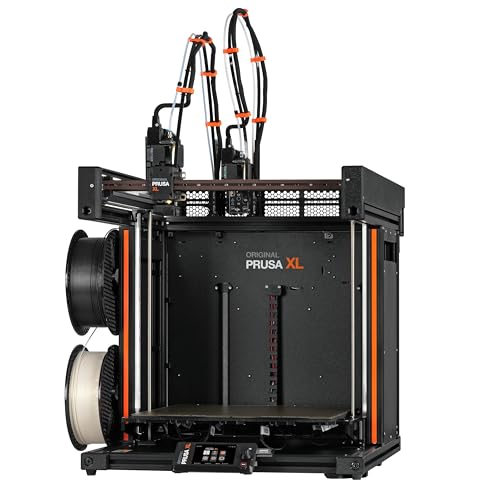
The Original Prusa XL Semi-Assembled 1-Toolhead offers a generous 14.17 x 14.17 x 14.17 inch print volume. This size suits functional prototypes, architectural models, or large artistic pieces that would otherwise require assembly. If your projects often exceed typical 220 mm cubes, this printer eliminates the need for splitting and gluing parts.
Consider the segmented heated bed, which heats only the zones under the print. This design reduces energy consumption and minimizes warping on large builds. For most users, the 1-toolhead configuration provides a solid entry point into the XL ecosystem.
Tool Changer vs. Single Nozzle Multi-Material
The XL’s tool changer sets it apart from single-nozzle multi-material systems. Each toolhead swaps independently, allowing you to combine PLA, PETG, TPU, or soluble supports without purging waste. This zero-waste workflow saves material and time, especially for complex assemblies.
If you need multi-material prints, the 2-toolhead version (the Original Prusa XL 2-Toolhead Multi-Material) offers a balanced upgrade. The tool changer also enables independent calibration per head, ensuring consistent quality across materials.
Assembly Effort and Support
The semi-assembled kit requires you to mount the gantry, attach the toolhead, and connect wiring. Prusa provides a detailed online manual and lifetime technical assistance. Most users complete assembly in a few hours, gaining valuable knowledge of the machine’s construction.
For those who prefer a ready-to-run setup, the fully assembled versions (like the Bundle of Original Prusa XL Assembled 2-toolhead) ship pre-tuned. The choice depends on your comfort with DIY work and time constraints.
Material Compatibility and Enclosure
The XL works with a wide range of filaments, including PLA, PETG, ASA, ABS, PC blends, and TPU. For engineering materials like Nylon or Carbon Fiber, an enclosure stabilizes the chamber temperature. The optional Original Prusa XL Enclosure integrates seamlessly with the printer’s frame and active filtration.
If you plan to print high-temperature materials regularly, consider a bundle that includes the enclosure. The Bundle of Original Prusa XL Assembled 1-toolhead with enclosure provides a complete package for professional environments.
Final Thoughts
After evaluating the Original Prusa XL Semi-Assembled 1-Toolhead, we find it excels for large-format prototyping and multi-material exploration without waste. For users who need dual-material prints or a fully assembled system, the Original Prusa XL 2-Toolhead Multi-Material offers a turnkey solution with two independent heads. Both models benefit from Prusa’s proven reliability and open-source ecosystem, making them strong investments for serious makers and professionals.
Frequently Asked Questions
What is the build volume of the Original Prusa XL Semi-Assembled?
The build volume is 14.17 x 14.17 x 14.17 inches (360 x 360 x 360 mm). This large format allows printing sizable parts without splitting or gluing.
Can I upgrade the toolhead count later?
Yes, the XL is modular. You can start with one toolhead and add up to five later. Prusa sells upgrade kits, and the firmware supports multiple heads natively.
Does the semi-assembled version require soldering?
No, the kit uses plug-in connectors for all wiring. Assembly involves mounting mechanical parts and connecting cables, following the step-by-step guide. No soldering is needed.
What materials can I print with the Original Prusa XL in 2026?
The printer supports PLA, PETG, ASA, ABS, PC blends, TPU, and many specialty filaments. With the optional enclosure, it handles high-temperature materials like Nylon and Carbon Fiber reliably.
