🔥 3D Printer Black Friday Deals: picks worth watching →
You have a 3D printer humming away, but you want to duplicate a broken part or scan a prototype. Finding the best buy 3D scanner can feel overwhelming with so many options, from entry-level units to professional metrology tools. This guide cuts through the noise to help you choose the right scanner for your projects and budget in 2026.
We have evaluated nine top models from leading brands like Creality, Revopoint, and 3DMakerpro. Whether you are a hobbyist, engineer, or educator, our reviews will point you to the perfect device. For more options, check out our best rated 3D scanner guide.




Buying Guide
Accuracy and Resolution
Accuracy determines how closely your scan matches the real object. For reverse engineering or precision parts, look for a scanner with 0.02 mm to 0.05 mm accuracy. The Creality CR-Scan Raptor achieves 0.02 mm, while the Revopoint POP 4 offers 0.03 mm. Entry-level models like the 3DMakerpro Fox deliver 0.07 mm, which is fine for larger objects. Higher resolution captures finer details, crucial for small items like jewelry or mechanical components.
If you need industrial-grade precision, the Revopoint MetroY Ultra boasts 0.01 mm single-frame accuracy. For most hobbyists, 0.1 mm is adequate. Consider what you scan most. For a deeper dive into budget-friendly options, see our best inexpensive 3D scanner article.
Scanning Speed and Ease of Use
Speed matters when you scan large objects or multiple items. The Revopoint POP 4 reaches up to 105 fps with GPU acceleration, while the Creality CR-Scan Raptor scans at 60 fps. For beginners, markerless tracking and anti-shake features simplify the process. The 3DMakerpro Fox uses markerless tracking, reducing setup time. The Creality Ferret Pro offers wireless scanning via Wi-Fi 6, great for portability. If you are on a tight budget, explore our best 3D scanner under $500 guide.
Object Size and Material Compatibility
Scanners handle different size ranges. The Creality Raptor scans objects from 5 mm to 2000 mm, while the Revopoint MIRACO Plus handles tiny screws to large machinery. For dark or shiny surfaces, blue laser scanners like the Revopoint MetroY Ultra scan without spray. The Creality Pika also scans black and metal surfaces directly. If you scan mostly small items, a structured light scanner may suffice. For larger objects, consider a model with multiple scanning modes. For more choices, check our best 3D scanner under $2K list.
Software and Connectivity
Good software makes scanning easier. Most scanners include proprietary apps like CrealityScan or Revo Scan. Look for features like AI hole filling, automatic alignment, and export to STL/OBJ/PLY. Wireless connectivity via Wi-Fi 6 adds convenience, as seen in the Creality Ferret Pro and Revopoint POP 4. Ensure your PC meets minimum requirements, especially for high-speed scanners. For budget picks, see our best budget 3D scanner roundup.
Final Thoughts
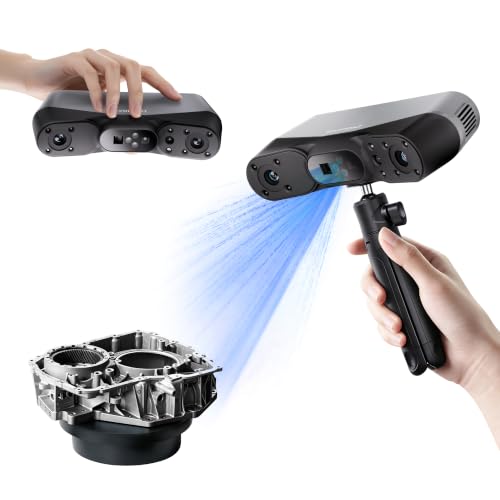
Choosing the best buy 3D scanner depends on your specific needs. For professional-grade accuracy and versatility, the Revopoint MIRACO Plus 3D Scanner, All-in-One Scan offers exceptional photogrammetric metrology and high-speed scanning. If you are a beginner or on a tighter budget, the 3DMakerpro Fox 3D Scanner provides a solid entry point with good accuracy and markerless tracking. Both models deliver excellent value for their respective tiers in 2026.
Frequently Asked Questions
What is the best buy 3D scanner for beginners in 2026?
The 3DMakerpro Fox and Creality Ferret Pro are excellent choices for beginners. They offer markerless tracking, easy software, and good accuracy for most hobby projects. Both are affordable and reliable.
Can I scan dark or shiny objects without spray?
Yes, many modern scanners like the Revopoint MetroY Ultra and Creality Pika use blue laser technology to scan dark and reflective surfaces directly. This saves time and keeps your objects clean.
What accuracy do I need for 3D printing?
For most 3D printing applications, 0.1 mm accuracy is sufficient. For precision parts or reverse engineering, aim for 0.02 mm or better. The Creality CR-Scan Raptor and Revopoint POP 4 deliver excellent results.
Do I need a powerful computer for 3D scanning?
Yes, high-speed scanners require a capable PC. Minimum requirements often include an Intel i7 processor, 16 GB RAM, and a dedicated GPU with 6 GB VRAM. Check each scanner’s specifications before purchase. For more tips, see our best rated 3D scanner article.