
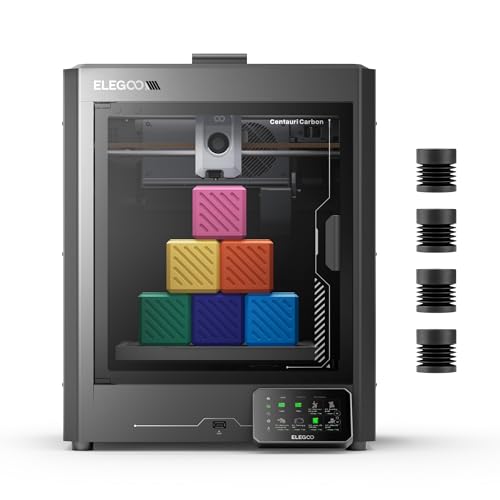
You have just unboxed your first 3D printer, and the excitement is real. But then comes the setup: leveling the bed, tightening belts, calibrating the extruder. It can take hours, and for many, that initial friction kills the hobby before it even starts. The ELEGOO Centauri Carbon aims to change that by offering a fully assembled, pre-calibrated CoreXY machine that promises high-speed printing right out of the box. In this review, we evaluate the Centauri Carbon and its sibling, the Centauri 2, to help you decide which one fits your workflow.


Buying Guide
Speed and Acceleration
Speed is a major factor when choosing a 3D printer, especially if you plan to produce multiple prototypes or functional parts. Both the Centauri Carbon and Centauri 2 boast a top print speed of 500 mm/s and acceleration of 20,000 mm/s², thanks to their CoreXY architecture. This means you can complete large prints in a fraction of the time compared to traditional Cartesian machines. For example, a detailed model that might take 12 hours on a slower printer could finish in under 6 hours on these models. If speed is your priority, either printer delivers, but the Centauri Carbon adds an enclosed chamber for better temperature control.
Build Quality and Frame Stability
A printer’s frame directly impacts print quality, especially at high speeds. The Centauri Carbon features a rigid, integrated die-cast aluminum frame that minimizes vibrations and maintains exceptional stability. Combined with automatic vibration compensation and pressure advance, it ensures smooth first layers and consistent, high-quality prints. The Centauri 2 uses a rigid aluminum frame as well, but without the die-cast construction, it may be slightly less robust for demanding materials. For users who plan to print carbon fiber reinforced filaments or other advanced materials, the Centauri Carbon’s solid build is a clear advantage. For a deeper look at other high-speed printers, check out our creality K2 pro review.
Material Compatibility and Hotend
The hotend determines which filaments you can use. The Centauri Carbon is equipped with a 320°C brass-hardened steel nozzle and an enclosed chamber with enhanced cooling. This makes it optimized for advanced filaments like carbon fiber reinforced filament, which produce strong, lightweight, and heat-resistant parts ideal for drones, automotive, and athletic applications. The Centauri 2, while capable of high-speed printing, does not specify the same high-temperature hotend, so it is better suited for standard materials like PLA, PETG, and TPU. If you plan to experiment with engineering-grade materials, the Centauri Carbon is the better choice. For more on material versatility, see our flashforge adventurer 5M pro review.
Ease of Use and Automation
Both printers are designed to be beginner-friendly, but they differ in automation features. The Centauri Carbon arrives fully assembled and pre-calibrated, with auto bed leveling, intuitive touchscreen controls, and a built-in chamber camera with dual LED lighting for real-time monitoring. The Centauri 2 also offers full auto calibration and a 5-inch touchscreen, plus a magnetic printhead cover and semi-automatic belt tensioner for easier maintenance. For beginners, the Centauri 2’s simplified workflow and remote monitoring via the ELEGOO Matrix app make it especially appealing. If you are new to 3D printing, you might also find our Beginner 3D Printers guide helpful.
Final Thoughts
Choosing between the ELEGOO Centauri Carbon and the Centauri 2 comes down to your material needs and desired level of automation. For makers who want to print advanced filaments like carbon fiber reinforced materials and value a rock-solid die-cast frame with smart monitoring, the ELEGOO Centauri Carbon 3D Printer is the clear winner. On the other hand, if you are a beginner or hobbyist looking for an affordable, easy-to-use machine that handles standard filaments with speed and precision, the ELEGOO Centauri 2 3D Printer offers excellent value and a seamless workflow. Both printers represent ELEGOO’s commitment to quality and innovation in the FDM space, making 2026 an exciting time to dive into 3D printing.
Frequently Asked Questions
Is the ELEGOO Centauri Carbon suitable for beginners?
Yes, the Centauri Carbon is designed for users of all skill levels. It arrives fully assembled and pre-calibrated, with auto bed leveling and an intuitive touchscreen, so you can start printing immediately without complex setup.
What materials can the ELEGOO Centauri Carbon print?
The Centauri Carbon can handle a wide range of filaments, including PLA, PETG, TPU, and advanced materials like carbon fiber reinforced filament, thanks to its 320°C nozzle and enclosed chamber.
How does the Centauri Carbon compare to the Centauri 2?
The Centauri Carbon features a die-cast aluminum frame and a higher-temperature hotend for advanced materials, while the Centauri 2 is more beginner-friendly with a simplified workflow and lower price. Both offer the same 500 mm/s print speed. For a broader comparison of 3D printer brands, see our anycubic vs bambu lab guide.
Does the ELEGOO Centauri Carbon have a built-in camera?
Yes, it includes a built-in chamber camera with dual LED lighting for real-time monitoring and time-lapse video capture, allowing you to check prints remotely via the ELEGOO Matrix app.