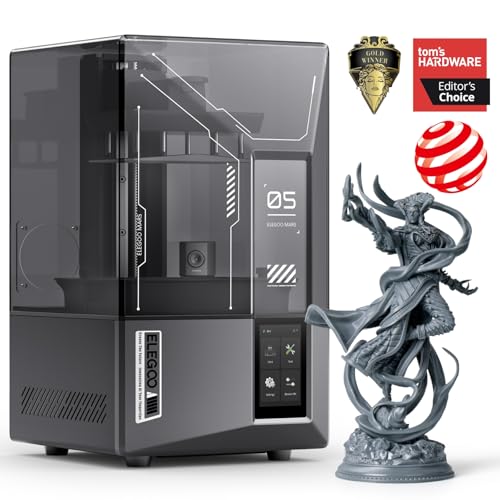

Imagine you have spent weeks designing a miniature figurine with intricate armor details and a flowing cape. You want the final print to capture every subtle curve and sharp edge, not leave visible layer lines across the face. That is the moment when choosing the right 3D printing technology matters most. In this guide, we compare resin and filament 3D printers to help you decide which path fits your creative goals in 2026. Whether you are a hobbyist seeking museum-quality miniatures or a maker prototyping functional parts, we cover the core differences in resolution, material properties, workflow, and cost. For a deeper look at entry-level options, see our best resin 3D printer for beginners 2026 guide.


Buying Guide
Print Resolution and Detail
If your projects demand razor-sharp edges and smooth curves, resin printing offers a clear advantage. The ANYCUBIC Photon Mono 4, Resin 3D Printer with 7” features a 10K mono LCD screen with a resolution of 9024×5120, giving you a pixel size of just 17×17 microns. This level of precision allows you to print facial expressions, chainmail, and small text without visible stepping. Filament printers typically produce layers of 0.1 mm or thicker, which can show ridges on curved surfaces. For miniature painters and jewelry designers, resin is the clear winner here.
Material Properties and Durability
Filament materials like PLA, PETG, and ABS are known for their toughness, impact resistance, and ability to withstand outdoor conditions. Resin prints, by contrast, are more brittle but can be formulated for flexibility or strength. The ANYCUBIC 2nd Gen Resin Technology ABS-Like Resin bridges this gap by offering higher toughness and low odor while retaining the fine detail of standard resin. If you need a part that snaps or flexes, filament still leads, but modern ABS-like resins are closing the gap for functional prototypes.
Workflow and Post-Processing
Resin printing involves more steps after the print finishes: you must wash the model in isopropyl alcohol, remove supports, and cure it under UV light. Filament prints are ready to use right after peeling off the build plate. However, the ANYCUBIC Photon Mono 4, Resin 3D Printer with 7” simplifies the process with a user-friendly 4-point leveling system that stays calibrated and a laser-engraved platform that improves adhesion and makes removal easier. For beginners, the extra steps of resin can feel intimidating, but many find the results worth the effort. Our anycubic photon mono M7 review discusses how newer models reduce post-processing time.
Build Volume and Print Size
Filament printers typically offer larger build volumes, often exceeding 220 x 220 x 250 mm, making them ideal for helmets, vases, or large functional parts. Resin printers have smaller build plates due to the nature of the technology. The Photon Mono 4 provides a build volume of 6.04″ x 3.42″ x 6.49″, which is ample for miniatures, dental models, and small prototypes. If you primarily print large objects, a filament printer is more practical. For detailed small parts, resin remains the superior choice. Explore the ELEGOO saturn 4 ultra review for a large-format resin option.
Final Thoughts
Choosing between resin and filament comes down to your primary use case: if you crave ultra-fine detail for miniatures, jewelry, or dental applications, the ANYCUBIC Photon Mono 4, Resin 3D Printer with 7” delivers exceptional resolution and a user-friendly experience, especially when paired with the ANYCUBIC 3D Printer Resin Bundle for consistent results. For larger, durable parts or quick prototyping, a filament printer remains a versatile workhorse. Both technologies have their place, and many hobbyists eventually own one of each to cover all bases.
Frequently Asked Questions
Is resin 3D printing harder than filament printing?
Resin printing requires more post-processing steps, such as washing and curing, but the actual printing process is often simpler because there are fewer moving parts and less need for bed leveling. The ANYCUBIC Photon Mono 4 features a 4-point leveling system that stays calibrated, making it accessible for beginners in 2026.
Can I use resin for functional parts?
Yes, but choose a tough resin like the ANYCUBIC 2nd Gen ABS-Like Resin, which offers higher impact resistance and low odor. Standard resin is brittle, so for parts that need to flex or bear load, filament materials like PETG or ABS remain more reliable.
How much does resin 3D printing cost compared to filament?
Resin printers themselves can be very affordable, with models like the Photon Mono 4 priced competitively. The ongoing cost of resin is higher per kilogram than filament, but the material cost per print depends on model size and infill. For small, detailed prints, resin can be cost-effective. For more on budgeting, visit our 3D Printers category page.
Which printer is better for miniatures: resin or filament?
Resin is overwhelmingly preferred for miniatures because it produces smooth surfaces and captures fine details like sword edges and facial features. Filament printers leave visible layer lines that require extensive sanding. For the best results, see our Best Resin 3D Printer for Miniatures guide.